
Concrete Volume Formula
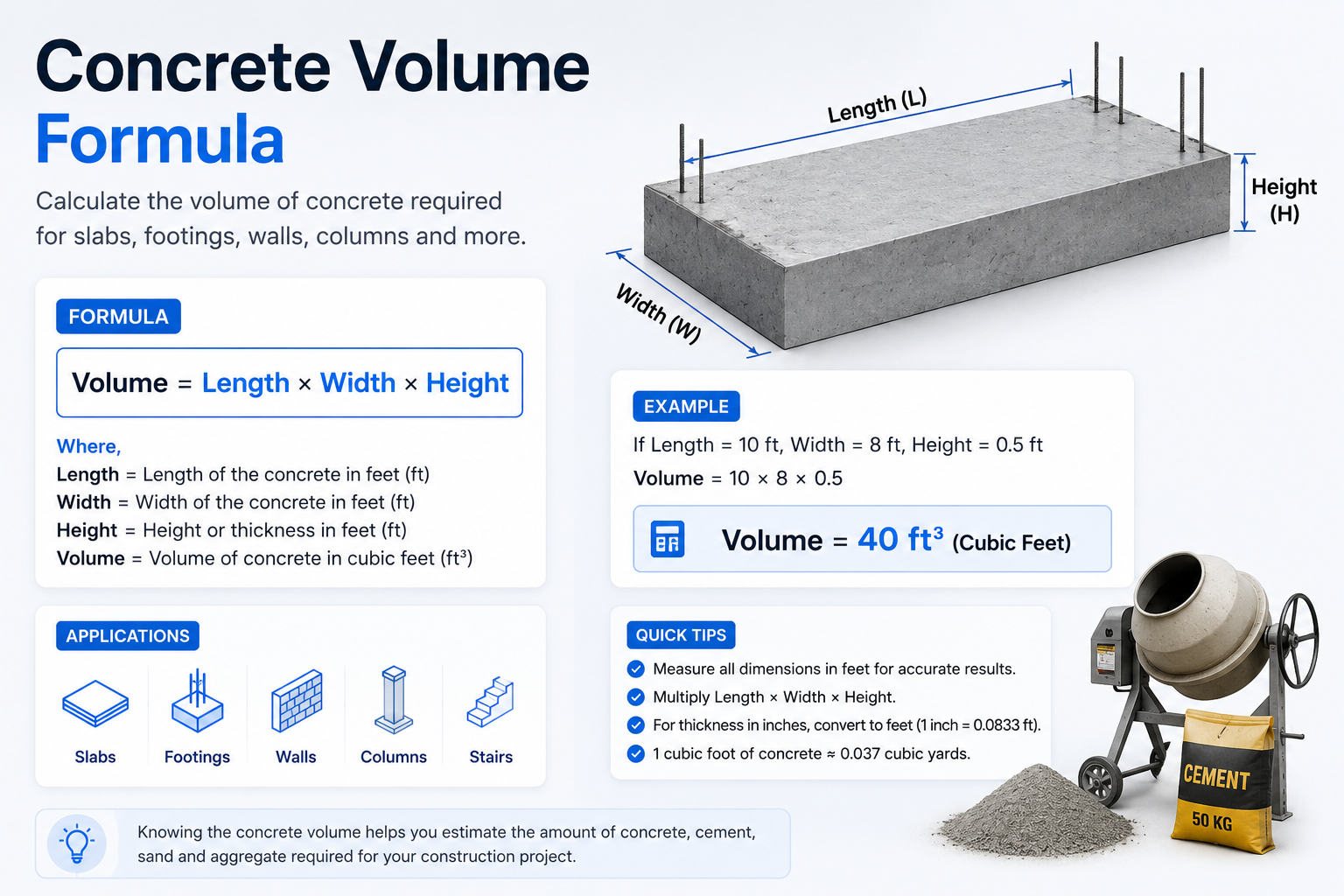
The Concrete Volume Formula is one of the most important formulas used in construction, renovation, flooring, and building projects. It helps estimate the exact amount of concrete required for slabs, driveways, sidewalks, patios, foundations, footings, garage floors, and many other structures. Builders, contractors, engineers, architects, and homeowners all use this formula to avoid material shortages and improve construction planning.
Concrete is measured by volume because it fills a three-dimensional space. This means the formula uses the total length, width, and depth of an area to calculate how much concrete is needed. Accurate volume calculation is important because ordering too much concrete increases project costs while ordering too little can delay construction work and create project problems.
Concrete Volume Formula
The standard formula used to calculate concrete volume is:
The answer is usually measured in cubic feet, cubic meters, or cubic yards depending on the project type and the measurement system being used.
Concrete Volume Calculator
How the Concrete Volume Formula Works
To use the formula correctly, first measure the total length of the area. Then measure the width and depth. After collecting all measurements, multiply the values together.
For example, if a slab is 10 feet long, 8 feet wide, and 0.5 feet deep, the formula becomes:
This means the slab requires approximately 40 cubic feet of concrete.
Common Concrete Volume Table
| Project Size | Depth | Concrete Volume |
|---|---|---|
| 10 × 10 ft | 4 inches | 33.33 cubic feet |
| 12 × 12 ft | 4 inches | 48 cubic feet |
| 15 × 10 ft | 6 inches | 75 cubic feet |
| 20 × 12 ft | 6 inches | 120 cubic feet |
| 25 × 15 ft | 6 inches | 187.5 cubic feet |
Why Accurate Concrete Calculation Is Important
Accurate concrete calculation is extremely important in construction because even small mistakes can affect the project budget and timeline. Ordering less concrete than required can stop the work before completion, while ordering too much concrete can increase waste and unnecessary expenses.
Professional contractors and builders always calculate concrete volume carefully before starting a project. Accurate calculations help improve material planning, labor management, transportation, and construction scheduling.
- Improves construction planning
- Reduces concrete waste
- Helps estimate project costs
- Avoids material shortages
- Saves time during construction
- Useful for slabs and foundations
- Provides accurate material estimation
Benefits of Using a Concrete Volume Calculator
- Fast and accurate calculations
- Simple and beginner-friendly
- Works on mobile and desktop devices
- Useful for DIY and commercial projects
- Provides instant concrete estimation
- Improves budgeting accuracy
- Reduces manual calculation mistakes
Frequently Asked Questions About Concrete Volume Formula
What is the concrete volume formula?
The concrete volume formula is Length × Width × Depth.
How do I calculate concrete volume manually?
Measure the total length, width, and depth of the area and multiply all three values together.
Why is concrete measured in cubic units?
Concrete fills a three-dimensional space, so it must be measured in cubic feet, cubic meters, or cubic yards.
Can I use this formula for slabs and foundations?
Yes. The formula works for slabs, patios, foundations, driveways, sidewalks, and most construction projects.
Final Words
The Concrete Volume Formula is essential for accurate construction planning and material estimation. Whether you are building a driveway, patio, slab, sidewalk, or foundation, using the correct formula helps save time, reduce waste, improve budgeting, and complete projects more efficiently. A concrete volume calculator makes the process even easier by providing fast and accurate results for professionals and beginners.