
Water Tank Volume Formula
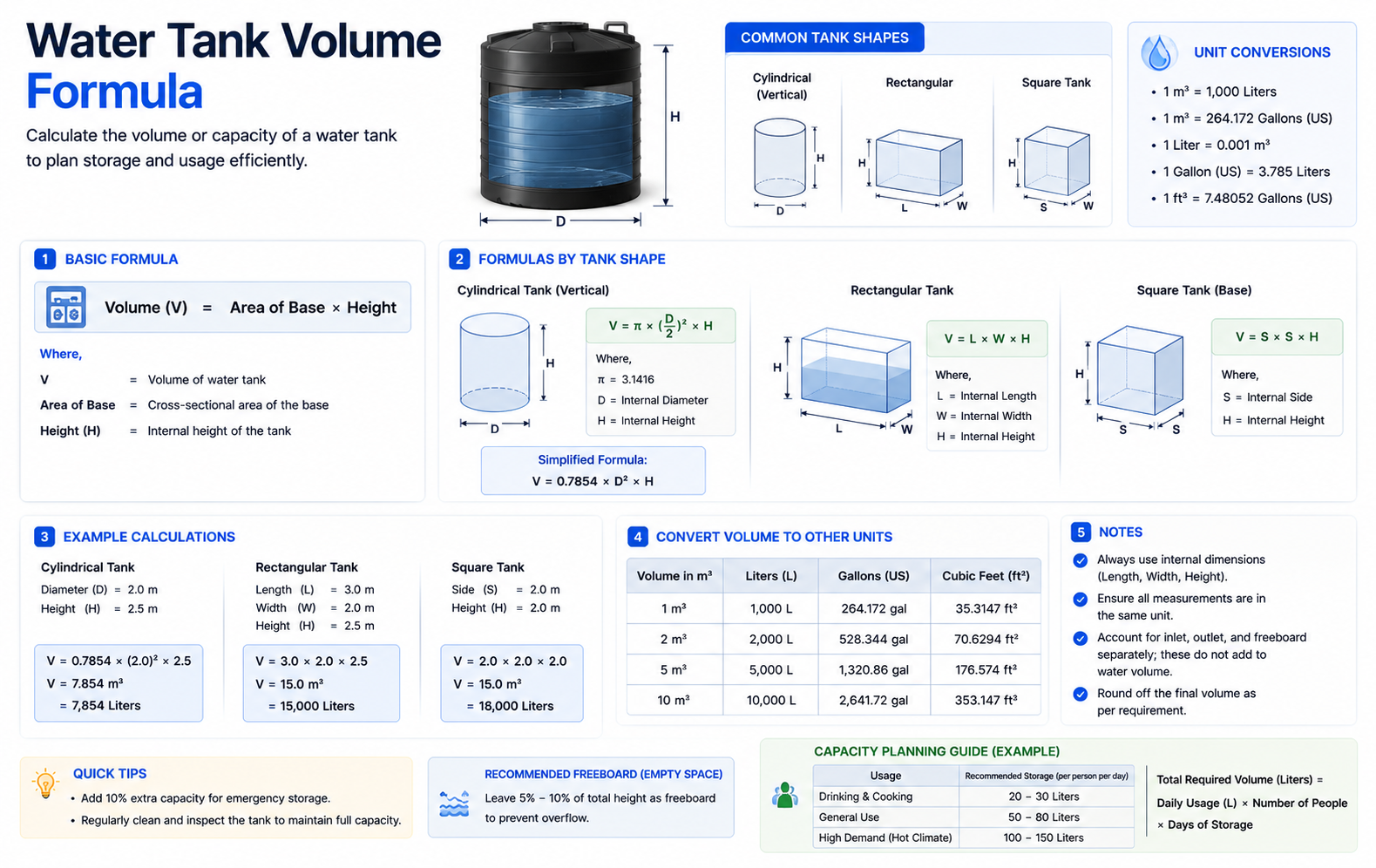
The Water Tank Volume Formula is used to calculate the storage capacity of water tanks, containers, reservoirs, and liquid storage systems. Builders, engineers, plumbers, contractors, farmers, and homeowners use water tank volume calculations to estimate how much water a tank can hold for residential, commercial, agricultural, and industrial purposes.
Accurate water tank volume estimation is important because it helps improve water management, plumbing planning, irrigation systems, construction work, and storage efficiency. Whether you are installing a household water tank, agricultural storage system, or industrial liquid container, knowing the correct tank capacity helps avoid shortages and improve system performance.
Water Tank Volume Formula
The standard formula for calculating rectangular water tank volume is:
The result is usually measured in cubic feet, cubic meters, or gallons depending on the unit system being used.
Water Tank Volume Calculator
How to Calculate Water Tank Volume
To calculate water tank volume manually, measure the tank length, width, and height. Multiply all three values together to calculate the total volume of the tank.
For example:
- Length = 10 feet
- Width = 5 feet
- Height = 4 feet
The formula becomes:
This means the water tank can store approximately 200 cubic feet of water.
To convert cubic feet into gallons, multiply the result by 7.48 because one cubic foot contains approximately 7.48 gallons of water.
Common Water Tank Volume Examples
| Tank Size | Volume | Approximate Gallons |
|---|---|---|
| 5 × 5 × 5 ft | 125 cu ft | 935 gallons |
| 10 × 5 × 4 ft | 200 cu ft | 1496 gallons |
| 12 × 6 × 5 ft | 360 cu ft | 2692 gallons |
| 15 × 8 × 6 ft | 720 cu ft | 5385 gallons |
| 20 × 10 × 8 ft | 1600 cu ft | 11968 gallons |
Why Water Tank Volume Calculation Is Important
Water tank volume calculation is important because storage systems must hold enough water for daily use, irrigation, industrial operations, and emergency supply. Incorrect tank estimation may lead to insufficient water storage or unnecessary installation costs.
Builders and engineers rely on accurate tank calculations for plumbing systems, agricultural water management, rainwater harvesting, and industrial fluid storage. Homeowners also use water tank formulas when installing rooftop tanks, underground storage systems, and garden irrigation tanks.
- Improves water storage planning
- Helps estimate tank capacity accurately
- Useful for irrigation systems
- Supports plumbing and construction projects
- Reduces water shortage risks
- Useful for industrial storage systems
- Improves liquid management efficiency
Benefits of Using a Water Tank Volume Calculator
- Fast and accurate calculations
- Simple and beginner-friendly
- Useful for residential and industrial projects
- Works on mobile and desktop devices
- Provides instant volume estimation
- Reduces manual calculation mistakes
- Improves water system planning
Where Water Tank Calculations Are Commonly Used
Water tank volume formulas are used in residential construction, industrial storage systems, agriculture, commercial buildings, plumbing projects, and irrigation management. Contractors and engineers use tank calculations before installing storage systems to ensure proper capacity and performance.
- Residential rooftop tanks
- Underground water storage
- Agricultural irrigation systems
- Industrial liquid tanks
- Commercial plumbing systems
- Rainwater harvesting systems
- Swimming pool storage systems
- Construction site water management
Frequently Asked Questions
What is the water tank volume formula?
The water tank volume formula is Length × Width × Height.
How do I calculate water tank gallons?
Multiply cubic feet by 7.48 to convert the result into gallons.
Why is water tank volume important?
Water tank volume helps estimate storage capacity for residential, agricultural, and industrial use.
Can this calculator work for rectangular tanks?
Yes. This formula works best for rectangular water tanks and containers.
What units are used for tank volume?
Tank volume is commonly measured in cubic feet, cubic meters, and gallons.
Final Words
The Water Tank Volume Formula is one of the most important calculations for water storage, plumbing systems, irrigation projects, and industrial liquid management. Whether you are installing a residential tank, planning agricultural storage, or designing an industrial water system, accurate tank volume calculation helps improve efficiency, reduce waste, and support better water management.