
BTU Calculation Formula
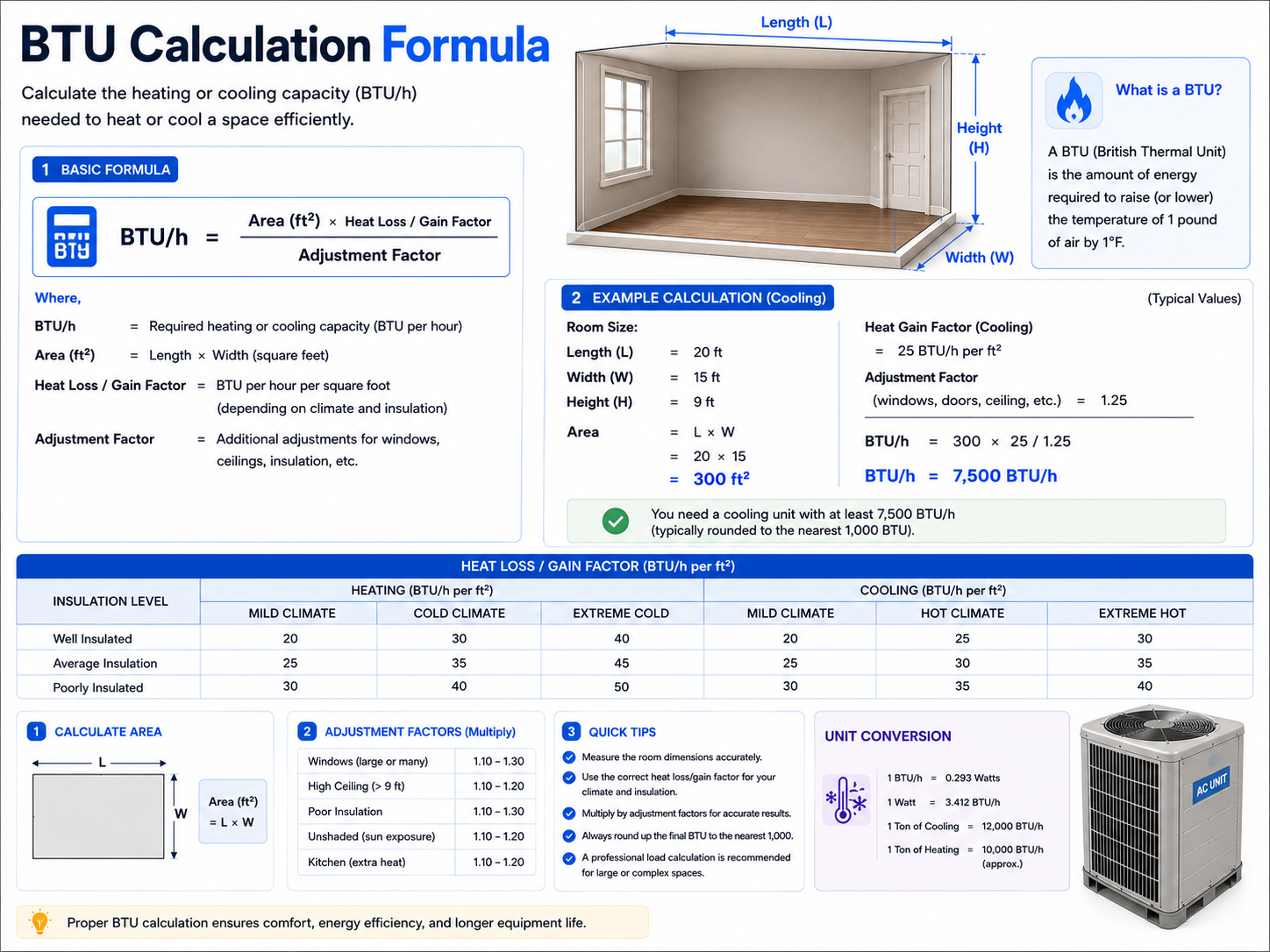
The BTU Calculation Formula is used to estimate heating and cooling requirements for rooms, homes, offices, buildings, and HVAC systems. BTU stands for British Thermal Unit, which measures the amount of heat needed to raise the temperature of one pound of water by one degree Fahrenheit. Contractors, HVAC technicians, engineers, architects, and homeowners use BTU calculations to select the correct air conditioner, heater, furnace, or cooling system for a space.
Accurate BTU calculation is important because an undersized system may struggle to heat or cool a room properly, while an oversized system can waste energy and increase electricity costs. The correct BTU estimate helps improve energy efficiency, indoor comfort, equipment lifespan, and monthly utility savings.
BTU Calculation Formula
The standard BTU formula commonly used for room cooling and heating estimation is:
Most residential calculations use approximately 20 BTU per square foot for cooling estimation, although actual requirements may vary depending on insulation, sunlight, ceiling height, and climate conditions.
BTU Calculator
How to Calculate BTU
To calculate BTU manually, first measure the room length and width to calculate total square footage. Then multiply the room area by the recommended BTU value per square foot.
For example:
- Room Length = 20 feet
- Room Width = 15 feet
- BTU Rate = 20 BTU per square foot
The room area becomes:
The BTU calculation becomes:
This means the room requires approximately 6000 BTU for cooling or heating.
Common BTU Calculation Table
| Room Size | Square Feet | Estimated BTU |
|---|---|---|
| 10 × 10 ft | 100 sq ft | 2000 BTU |
| 12 × 12 ft | 144 sq ft | 2880 BTU |
| 15 × 15 ft | 225 sq ft | 4500 BTU |
| 20 × 15 ft | 300 sq ft | 6000 BTU |
| 25 × 20 ft | 500 sq ft | 10000 BTU |
Why BTU Calculation Is Important
BTU calculation is important because heating and cooling systems must match the size of the room or building. A low-capacity HVAC system may run continuously without reaching the desired temperature, while an oversized system may cycle too quickly and reduce energy efficiency.
Accurate BTU estimation helps homeowners and contractors choose the correct air conditioning and heating equipment for residential and commercial projects. Proper sizing also improves indoor air quality, comfort, and long-term system performance.
- Improves heating and cooling efficiency
- Helps select correct HVAC systems
- Reduces electricity costs
- Improves indoor comfort
- Prevents equipment overload
- Useful for residential and commercial buildings
- Supports energy-efficient planning
Benefits of Using a BTU Calculator
- Fast and accurate BTU estimation
- Simple and beginner-friendly
- Useful for AC and heating selection
- Works on mobile and desktop devices
- Reduces manual calculation mistakes
- Improves HVAC planning
- Provides instant heating and cooling estimates
Where BTU Calculations Are Commonly Used
BTU formulas are widely used in HVAC installation, construction, architecture, and home renovation projects. Air conditioning companies and heating contractors rely on BTU calculations before installing cooling systems and furnaces. Homeowners also use BTU calculators when purchasing portable air conditioners, heaters, and window AC units.
- Residential air conditioning systems
- Commercial HVAC systems
- Portable air conditioners
- Heating furnaces
- Office cooling systems
- Warehouse climate control
- Apartment heating systems
- Energy-efficient building design
Frequently Asked Questions
What does BTU mean?
BTU stands for British Thermal Unit. It measures heating and cooling energy.
What is the BTU calculation formula?
The BTU formula is Room Area × BTU Per Square Foot.
Why is BTU important?
BTU helps determine the correct heating and cooling capacity required for a room or building.
Can I use this calculator for air conditioners?
Yes. The BTU calculator helps estimate air conditioner and heating system requirements.
What happens if my AC has low BTU?
An undersized AC system may struggle to cool the room efficiently and may increase energy usage.
Final Words
The BTU Calculation Formula is one of the most important calculations for heating, cooling, HVAC planning, and energy efficiency. Whether you are installing an air conditioner, selecting a heating system, or planning a commercial HVAC project, accurate BTU estimation helps improve comfort, reduce electricity costs, and support better climate control performance.